Negotiation Made Easy

A significant amount of your time is spent selling when starting a company. Assuming you are good at selling your company/product/vision, you will often get to the point where you need to close the deal. In between the selling and signing the contract is a chasm that many inexperienced entrepreneurs struggle to cross: negotiation.

Negotiation is simply the act of agreeing on terms for a deal. If you have never done it before you may envision it like a TV show with adversarial parties sitting across a table trying to crush the other party. That is rarely the case. Most negotiations are between two parties who really want to reach a mutually beneficial deal and just need to establish the terms of the deal. That does not mean people will not try to take advantage of you, but let us assume a basic negotiation where both parties have good intentions.

The actual act of negotiation is simple. One party makes an offer and the other party either accepts the offer, makes a counter offer or ends the negotiation. This continues until the parties reach an agreement or part ways.

But how do you know what offers to make, and whether the offer you get from the other party is a good offer? To answer that you need to understand some basics of negotiation and a simple process will help.

Step 1: You Win or Lose Before You Start

It’s a general misconception that whether you get good terms for a deal is based on whether you are a good negotiator. That is almost never true. Good negotiators know that the person who gets better terms is the person who has a better BATNA.

BATNA stands for Best Alternative To Negotiated Agreement and represents the worst case scenario for both parties if no agreement is reached. Whoever has the best outcome if there is no agreement has the advantage in the negotiation because they have less incentive to close the deal and can more easily walk away.

For example, let us say you are selling an apartment and someone moving to this city would like to buy it. If there are only a few apartments for sale and the buyer needs to move in the near future you have the advantage as the seller. You could choose not to sell the apartment and wait for another buyer (your BATNA) while the buyer would have to desperately find another of the few apartments for sale quickly (their BATNA). On the other hand, if there are many apartments for sale and the buyer is buying the property to rent it out then the buyer has the advantage. You might not be able to sell your apartment since there are so many for sale and the buyer can simply wait for a better deal elsewhere. In both cases, the BATNA determines which party has the power in the negotiation based on their incentive to close the deal.

The lesson here is to make sure you optimize your BATNA before even starting a negotiation. Consider some common deals you might close and how to position your BATNA for success:

  • If you are raising money, make sure you have plenty of runway (9-12 months at least) so that you are not under pressure to close quickly. Also be sure to line up as many potential investors as possible so you have your choice (and fallback).
  • If you are selling your product, always have a healthy pipeline of customers and never bet everything on selling to one particular customer. Try to avoid having one customer make up more than 50% of your revenue.
  • If you are hiring employees, start the hiring process long before you will need the person since it will take time to find the right candidate. Always interview multiple people for the position even if you think you have found the right fit, just in case you can’t close the deal.

Step 2: Get Into The Zone

While both parties have a BATNA (worst case), they also have a preference for the terms of the deal if it closes (best case). For example, if you are buying a house there is a price you would prefer to pay (practically speaking) and the seller has a price they would like you to pay. The combination of your BATNA and your preferences forms what is called the Zone Of Possible Agreement or ZOPA.

You can visualize the ZOPA as follows:

Negotiation

As you can see, both the buyer and the seller have a range of acceptable prices between their BATNA and their preference. The ZOPA is the overlap in these ranges, the difference between their BATNAs. Note that while this diagram uses Cost as the dimension of negotiation, it could easily be anything including the length of contract, legal terms or location.

If a deal gets closed, it will be in the ZOPA. Ideally, assuming both parties are interested in a mutually beneficial agreement, you would pick the midpoint of the ZOPA and that would be the terms of the deal. 

How then do you know where the ZOPA lies? Very few partners will tell you their BATNA, even if they have the best intentions. They have no incentive to reveal their true BATNA and if they can convince you their BATNA is higher/lower than it really is then they can convince you the ZOPA is smaller and get favorable terms.

And in that tension is where negotiation exists.

Step 3. Choose Your Strategy

When you are negotiating you know your BATNA and your preference but not for the other party. Hence, you know one end of the ZOPA but not the other end. There are a number of strategies you can employ to determine the scope of the ZOPA and/or reach a deal on favorable terms.

Here are some examples:

  1. High Initial Offer. To try and determine the BATNA of the other party, you can start with an arbitrarily high (or low) offer. Anchoring the negotiation will force the other party to start higher (or lower) than they might have otherwise and hopefully expose their BATNA quickly. This is why cars are priced so highly on the lot of a dealership, even though no one pays those prices. Dealerships want to determine your capacity to pay and motivation to buy.
  2. This or That. The initial offer does not need to be a single offer and instead could be two different offers with different kinds of terms. For example, you might make two offers of a loan where one has a high interest rate while the other has a pre-payment penalty. The other party, in indicating their preference for one of the options, will help you understand the ZOPA and guide the negotiations in a positive direction.
  3. Iteration. Since neither party knows enough about the other, you can make offers back and forth in an iterative fashion and slowly converge on a result in the middle. Each offer moves toward the other party’s previous offer by some small amount. This slow process of back and forth allows you both to understand the other party’s range and ensure you end up somewhere in the middle of the ZOPA. Most international diplomacy involves this kind of strategy since the parties disclose so little of their internal plans.
  4. Take it or Leave it. In this method, you make an offer to the other party that they can either accept or not but that will be the end (no counter offers). Since you don’t know the other party’s BATNA, you make a guess and give them an offer based on that guess. This is most common when one party knows it has the superior BATNA and can force the deal to be more favorable to them.

Whatever strategy you choose, it is important to consider the impact of the initial offer especially if you are making the initial offer. Whatever the initial offer you make, you will rarely get better terms and in almost all cases you will get worst terms. Hence, you need to make sure that your initial offer is not your BATNA or you will not be able to iterate with your partner.

For example, when negotiating your salary for a new job you should realize that when you are asked for your current salary they are asking you to make an initial offer. You should not ask for a million dollars, but you should tell them what you think you are worth and not the least amount you are willing to accept.

The best negotiators are the ones who can convince you that their BATNA is much different than it really is and in doing so get favorable terms on a friendly basis.

Step 4. Plan For The Long Term

Unlike selling your house, deals that you close when building your business will likely impact your business for the long term. You want to build a positive relationship with your customers, employees and investors that will span many deals and many years. Hence, you need to optimize for long term relationships and not just short term deal terms. This means choosing a strategy that will maximize both the terms of the deal and future deal potential.

With this in mind, it is often not a good idea to pursue aggressive strategies and hard nose negotiation where you win a given deal but decrease the likelihood of future deals. At the same time, friendly but prolonged negotiations can give partners the impression that you are hard to deal with and have a similar negative effect on future deals. Being practical and productive in negotiations will establish your reputation and open doors in the future.

For example, when hiring people for a start up company it can be a good idea to pursue the This or That strategy where you give the employee a choice between a low salary and high equity or high salary and low equity. This gives the employee a chance to show their preference and reduces the amount of negotiation necessary to reach a favorable term.

Conclusion: Negotiations Are Not Basic

While the discussion here involves a single dimension of negotiation where each party has a single BATNA, preference and ZOPA, that rarely occurs. In most negotiations there will be many different dimensions such as cost and time, each with their own ZOPA. You will need to give in on some terms to get better outcomes on other terms. Always keep track of the terms that are most important to you and never drop below your BATNA or else you may find yourself in deals that are not worth doing.

To learn more about negotiation I suggest reading Getting to YES, now included on the Reading List

Recommended Reading

While I would like to think this blog is a useful resource to learn about starting companies, there are many important topics that I will never get into great detail. I have started to assemble a Reading List that includes all of the books that I have found useful. You can find it by clicking on Reading on the menu at the top. If you have the time, I recommend any/all of them as important background on your startup journey.

Sean on Startups Recommended Reading List

Note that many of the books on the list will not appear on other start up reading lists. I find books that go deep into one topic with scientific and/or large scale studies to back them up to be the most useful learning tools. Priceless, for example, boils down decades of research into behavioral psychology to help you understand how to price your products. The fundamentals you learn there are almost universally applicable in business and not biased by my opinion or others.

If you know of other books that I should add to the list, please let me know. Enjoy!

(Note: Yes, those are affiliate links on the reading list page. Feel free to not click on them and search for yourself, but I need to pay the hosting fee for this blog somehow. There isn’t enough money in affiliate fees to motivate me to recommend something I don’t truly think is useful.)

The Difference Between Impossible and Really, Really Hard

Starting a company is very hard. You put every ounce of your energy into the new business, fighting for every new customer and struggling to make ends meet. In the midst of the chaos, it is very easy to lose track of whether you are making progress or just running in circles.

Every company runs into a wall right around their product launch, when the initial excitement of the start up wears off and the first version of their product makes contact with reality. Reality is a harsh place and even the brightest dreams never quite work the way you would expect. Success fails to come easily and you sit there wondering if your idea, which seemed brilliant a week ago, can really work at all.

At that point, many first time founders will start thinking of a pivot. The original idea isn’t working out exactly like you expected but you have another, equally brilliant idea that will be much better. This new idea has not had to survive contact with reality so it will always look more attractive. You start to think the original plan is impossible but this new path will definitely work.

But, is the original plan really impossible or is it just really, really hard?

Don’t get me wrong, pivots can be an important part of start up success as almost every successful company ends up doing something different than what they started out doing since they learn from the market. However, pivoting too early or often can actually hurt your chances of success. You should not pivot unless you are positive that it is the best thing for your company.

Here are some questions you should answer before deciding for or against a potential pivot in those early days.

Question 1: Have you followed through on your go to market plan?

It is easy to panic if you begin to test your concept in the market and things don’t go as you expect. Even if you were able to demonstrate demand with alpha customers, raise funding and recruit a team, there is no guarantee that customers will flock to you when you launch. If your launch doesn’t give you immediate benefits then you will feel panic setting in.

Making good decisions when emotions and stress are high is very difficult. That is why you laid out a plan for your go to market strategy (see Go To Market To Win) including specific milestones that you would aim for and how you would achieve them. Those milestones are important, because they give you a decision making framework that is above all of the emotions of the launch. Do not make decisions until you hit your next checkpoint to ensure that you have given it a chance to work.

Even if the early results don’t match all of your original expectations, look for promising signs and clear feedback from the market. Perhaps your pricing model is too aggressive or there are certain customer segments that are working well that you should lean into. Remember that whatever concept you might have started with, you will need to refine it as you learn from the market.

You should not continue trying to force a product that is clearly not working, but you need to be sure you have given your product a chance. Sticking to your go to market plan and avoiding panic are important parts of doing that.

Question 2: Do you have enough time for a pivot?

Pivoting your company is a lot like starting over again. While you might be able to use some of the assets you have accumulated along the way, you will be at a much earlier stage of development on the new idea than you were on the old one. You will need to start over again with your market planning, prototyping, customer development and strategizing. All of that will take time, just like it did the first time you did it.

The unfortunate truth is that when companies get the most desperate they start to favor pivoting as a solution to their problems. Often, this means they are trying to pivot when they have only months of runway left, which is not enough time to restart their go to market strategy. While it is true that your current business might not be working, if you only have a few months left then you likely don’t have enough time to make a new business work either. Be very practical about your existing runway and whether a pivot is really an option for you.

Question 3: Is your team on board?

At the end of the day, your company is made up of people. Maybe it is just you or maybe you have a team of dozens. Either way, pivoting is a traumatic event for everyone involved. You are, in essence, admitting that your previous plan which you used to recruit and motivate them, was flawed. The passion that drives early stage companies can quickly deflate.

You cannot change your team as quickly as you change your business so make sure that the team you would hire for your new idea and the team you have already are almost the same. If they are not, then you are faced with rebuilding your team at the same time you rebuild your business which is very hard.

Assuming your team is right, make sure they are on board. If you think a pivot is the right move but they are still committed to your old concept it is unlikely you can pull them along. Besides, if you can’t convince your team that it is a good idea then maybe it isn’t.

Impossible vs Really, Really Hard

All of this should make you realize that the difference between Impossible and Really, Really Hard is difficult to see when you are in the moment. Start up companies are at least really, really hard and often impossible so it is easy to confuse the two. While you don’t want to waste your time on something impossible, all the value and benefits of starting a company come when you overcome things that are really, really hard.

Whatever you choose, be sure not to waver. If you pivot and then swing back again you aren’t pivoting, you are waffling. Choose a direction and stick with it.

Go To Market To Win

There are only four kinds of events in the life of your company that are likely to get covered by the press:

  1. Acquisition
  2. New Funding
  3. Product Launch
  4. Partnership

Incidentally, those are also in the order of the likelihood of the press covering the event. These events are newsworthy because they are also the most important points of your company history.

Of the four, the one you have the most control over is the Product Launch. This is the point where your new product will be unveiled to the world and is your best chance to spread the word. A product is, of course, new only once.

Many companies will put together a launch plan, complete with a blow out launch party. Fewer will put together a comprehensive Go-To-Market strategy that includes the launch as part of the plan. While a good launch plan may make a splash, a good go-to-market strategy can position you to be successful.

So, what makes a good go-to-market strategy?

1. Plan for the Future

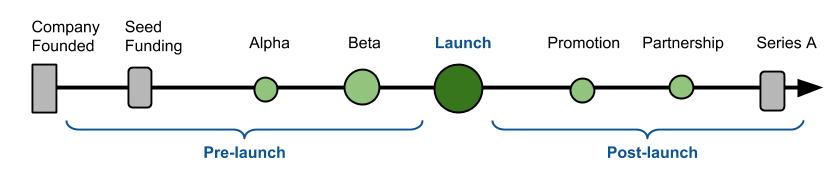
A good go-to-market strategy will start well before the launch and end at the first milestone after your launch. An example of the Go-to-market timeline for a company is below:

Go-To-Market

In this diagram the grey boxes are company milestones and the green circles are activities to help reach those milestones. The phases of the Go-To-Market timeline are broken down into three parts:

  • Pre-launch. Leading up to the launch, these are activities designed to help make the launch a success. The Alpha test is a small number of potential customers who help you refine your product. The Beta test is a larger number of potential customers who help you refine your business model. Coming out of the pre-launch phase you should feel confident in your product, first time experience and marketing strategy.
  • Launch. This is when your product is available to the general public. You will kick off your marketing strategy (see Marketing for Engineers) and hopefully get press coverage. You should have a party to celebrate this milestone with your team, but don’t count on your party to help your business.
  • Post-Launch. After the launch, you are now operating your business. At the least you want to maintain whatever momentum was provided by your launch, but ideally you begin growing and operating your business. This is where measuring your LTV and CAC become critical (see The Most Important Equation for Your Business).

By mapping out your full go-to-market timeline you will be able to think of the launch as a part of your strategy, not an end in itself.

2. Use the Launch to your Advantage

Since the launch is only part of your strategy, it is important that it helps you achieve your goals and is not a goal itself. Depending on the milestone you are trying to achieve, your launch may take on different forms:

  • Customer Growth. If your goal is customer growth, you want to reach as many potential customers as possible and let them know your product exists (raising awareness). This will vary depending on your business but remember that very few customers will read industry press (unless they are in your industry). Getting covered in TechCrunch might make you feel great but if you are offering a new service to kindergarden teachers you will not find many customers that way.
  • Fundraising. If your goal is to raise more funding, then your launch should expose you to as many potential investors as possible. This can mean speaking at conferences, participating in launch competitions or being covered in industry press (this is where TechCrunch can help). However, fundraising is rarely a goal on its own so don’t lose this opportunity to grow your customers as well.
  • Recruiting. If your goal is recruiting, you should try to reach as many potential employees as possible and make it clear why your company is a great place to work. This usually means talking about what and how you do things in detail. For example, you might open source software, publish design plans and give tours of your production facilities. Industry press can help here as well.

You might have more than one of these as goals and if so, your launch will have many different dimensions. The more you try to achieve with your launch, the longer you will need to prepare so begin the planning early.

To ensure that you can measure success after the launch, be sure to set some quantitative goals for the launch. How many customers do you want to have one week after launch? How many articles do you want written? How many inbound job requests? Having numeric goals makes it much easier for you to prioritize and measure success later.

Whatever your goal, make sure your launch helps move you towards it. You only get to launch once and it is a powerful weapon so get the most out of it.

3. Have booster rockets ready

Many companies execute well in the Pre-launch phase, execute their launch well but fail to plan for the post-launch. When that happens the business will stall and the company will scramble trying to regain its momentum.

To avoid that, you should have your booster rockets ready before you launch. Booster rockets are activities and plans that will help you continue to grow after your launch.

Examples of common booster rockets are:

  • Paid Marketing Campaigns. These are part of your marketing strategy already and will allow you to continue to acquire customers even after the free marketing from the press coverage of your launch ends.
  • Partnerships. Partnerships with other companies can open up new customer acquisition channels and help validate your business.
  • Product Updates. Improvements to your product, including new features, keep the product fresh and attract new customers. For example, mobile applications may plan out updates every few weeks after the launch so that the app continuously improves (and increase the chances that users tell their friends).

Just like your launch is not a goal, you should not fire all of your booster rockets at the same time. Ideally you can pace them out so that they fuel sustainable and ongoing growth instead of a single spike.

Getting To Market is Hard

It might seem like this is more effort than most companies put into their launch strategy. You read about companies launching every day who seem to just open up their product to the world and sit back as customers flock to them. If that were the case then many more start up companies would survive.

Most of the successful start up companies you read about today have struggled during the go-to-market phase including AirBnB, Dropbox and even WhatsApp. When you struggle, you will be in good company.

If struggling is part of the journey, then the best thing you can do is plan ahead to give yourself every advantage possible. Your go-to-market strategy can’t guarantee success but it can help you increase the chances of success.

Besides, if you’re going to play why not play to win?

The 5 Minute Guide to Advisory Boards

“If we knew what we were doing, it wouldn’t be called research, would it?” – Albert Einstein

It is impossible to know everything that you will need to know to build a successful business before you start. While you should have some industry expertise, some experience building products and a decent understanding of start up fundraising there will be many twists and turns along the way that no one can predict. If you were to spend the time to become an expert in everything you might need, it would take dozens of years and you would never get started.

So, by definition, when you are starting a company you are in over your head. That is both thrilling and scary at the same time. Good luck!

One of the many ways you can increase your chances of success is to assemble a team of advisors for your new company. Advisors can fill in some of the gaps you have in your own knowledge and experience and provide outside perspective on important decisions. When done well, advisory boards can provide an invaluable resource for your company. However, done poorly they can provide a distraction when you can least afford one.

Step 1. Picking Good Advisors

When you are considering who might be a good advisor, here are some good criteria. They should:

  • Have expertise in at least one area that is at the core of your business.
  • Have a strong network to connect you to others when necessary.
  • Provide advice and insight that is thoughtful and specific to your situation.
  • Be someone who you like and respect.

If someone doesn’t meet these criteria they can still be an informal advisor, but it likely does not make sense to make them a formal advisor. Formal advisors have a formal relationship with the company because they can materially help the company succeed and you compensate them in some way for that. Informal advisors have a friendly relationship with you and can be helpful just like any of your friends. The difference is subtle, but in general formal advisors commit more time and effort on behalf of your company. Whether you need formal advisors for your company is completely up to you, but most successful companies have at least a few formal advisors.

The good news is that almost everyone loves to be an advisor for start up companies. As an advisor you get to learn a new business, meet some passionate people and help work on new problems while not needing to invest a lot of time. It is rare that anyone, no matter how successful or distinguished, would turn down an advisory opportunity if they like you, find your business interesting and have the time available. So, be aggressive in recruiting advisors and don’t be embarrassed to reach out to someone you do not know.

Step 2. Setting Up and Advisory Board

Once/if you’ve identified some potential formal advisors you should give some thought to the overall advisory board. The name “advisory board” is somewhat of a misnomer as, unlike your board of directors, your collection of advisors is unlikely to ever meet together at the same time. Some key points when assembling your advisory board:

  • It should have at least 2 but not more than 4 members. You want at least 2 perspectives on important decisions but managing more than 4 advisors is too time consuming to be useful.
  • Expertise among the advisors should be well distributed. You want to cover as many areas as possible so you want a diversity of advisors since you don’t know what questions you might face. Having two advisors with exactly the same expertise would be a waste since they should, in theory, tell you the same thing.
  • Advisors should be compensated with between 0.1% and 0.5% equity (depending on stage and value they add). If an advisor isn’t worth that much you shouldn’t make them a formal advisor to the company. Equity should vest monthly over at least two years.
  • You should set expectations on how often you need their help and how much of their time you require. Establish this up front so there are no surprises on either side later. You should talk to advisors at least every quarter but likely not more than once a week (the more time you want the higher the equity would be as well).

The reason that you will rarely, if ever, have a meeting of all the advisory board members is that typically their experience is so varied as to make such a meeting unproductive. The best way to make use of advisors is to have them engage with specific problems and issues you and your team are facing that are within their area of expertise, as if they are an extension of your team. Treating advisors like members of the team usually creates the most productive chemistry.

Advisors should all sign advisory agreements that are a combination of the advisor contract and NDA. Your law firm should have a standard advisory agreement that you can use.

Step 3. Using Your Advisory Board

Now that you have an advisory board in place, it’s time to make use of them! It is easy to set up an advisory board and not utilize it effectively because of everything else going on around you, so it can help to make using the advisory board part of your process. A good use of your advisory board may look like the following:

  1. When a new advisor joins, have them present something from their area of expertise to your entire team. It is a great way to introduce them to the team and learn new things.
  2. Hold quarterly sessions with each advisor to either review the product roadmap, talk about your sales pipeline or brainstorm solutions to hard problems – depending on their area of expertise. Having this regular cadence will help build a habit of using the advisors.
  3. Encourage your team to connect with advisors directly over email with questions whenever they occur. Having a single point of contact for advisors will limit their usefulness and having them build relationships with your team will make it easier for them to help.
  4. Send regular updates to the advisors on progress your company has made. Since you are already sending regular updates to your investors and board members, you can just send a slightly watered down version to the advisors. The more they are up to date on your business, the more helpful they can become.

Remember that your advisors have their own day jobs and are likely very busy, so they don’t spend every waking minute thinking about your company like you do. You should be very specific in asking them for things and giving them clear ways to contribute to your success since it might not be clear otherwise. By their nature advisors want to be helpful so tell them explicitly how to be helpful.

Conclusions

Learning lessons the hard way can cost you time and money, adding additional risk to your already risky new venture. Advisors can help you avoid some of those pitfalls since they have already learned those lessons. It is also helpful to have someone on your team who can critique your pitch, challenge your assumptions or validate your decisions.

Since you are in over your head in starting a company, you need to give yourself every advantage. Having an advisory board is like having backup, they won’t make you successful but they can help when you need it.

Marketing for Engineers (aka Growth Hacking)

So you are building a new product. Great! However, one of the worst mistakes you can make is to wait for it to be done before thinking about how you are going to market it. You should be thinking about how you will reach users and convert them into customers at every step of your development process.

The following is a basic framework you can use to think about marketing your product that you can consider at every step along the way.

1. Practice Telling Your Story

The first thing you should do, before even starting to build your product, is to understand how you will explain it to your customers. What problem does it solve? How does it work? Why is it the best option? Amazon takes this even farther, asking product managers to write the press release for the product before they start building it. Working backwards forces you to think about the product from the perspective of customers, instead of building a product just for the sake of building.

You should test this story by telling it to potential customers continuously during development. When you have wireframes, show them. When you have a prototype, demonstrate it. Do not wait until the product is “done”, because by then it might be too late to learn how it needs to change to match the story that customers want to hear.

You will know that you have mastered the storytelling for your product when describing it to potential customers comes naturally and the product tells most of the story for you.

2. Model Customer Conversions

It is easy to fall into the trap of optimizing your user interface for expert users of your product. You are an expert user of your own product, after all, and it is natural to want to optimize it for yourself. However, the most important feature of any product is the first time user experience  (which is how the customer becomes a customer in the first place). If you don’t obsess over the initial experience, customers may give up and never make it to the the point where your expert user interface has a chance to shine.

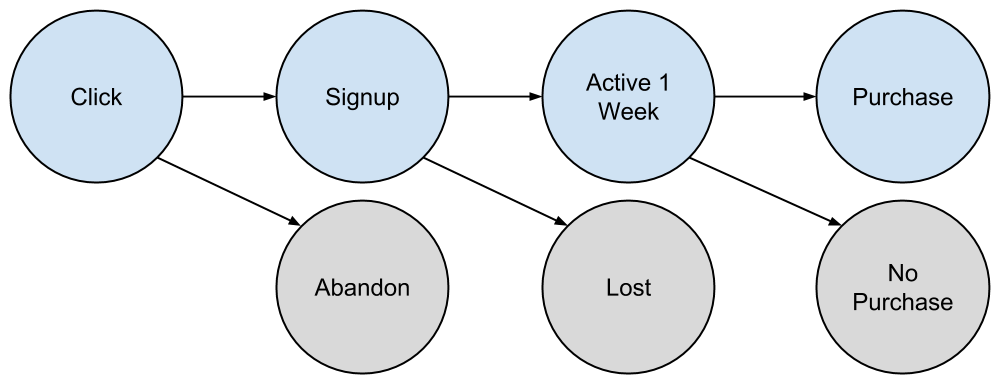
You can think about your first time experience as a sequence of events. For example:

flow

This example sequence is simple, with the blue circles representing the actions we want the user to take and the gray circles representing alternatives. For this product, the ideal first time experience is as follows: the user clicks on a link, signups up for the service, stays active for one week (is retained) and eventually makes a purchase. At each step the user could have failed to complete your preferred action (instead of signing up for the service they abandon the registration page) and this represents a lost opportunity. By understanding this flow you can understand how you expect customers to progress from prospects to ideal customers and where you might lose them along the way.

Of course the first time user experience for your application will be different, but it is composed of some number of steps that you can set up in the same way. There are some great examples of first time user experiences on FirstTimeUX. Your goal is to figure out these steps and make sure you can measure them effectively using your analytics solution.

The very last step should be the ideal behavior of an ideal customer (full purchase, invite 10 friends, etc.) such that a user that completes all the steps in your flow is your ideal customer. By measuring how many users achieve each step you will understand how effectively you convert prospects (clicks) into ideal customers. If you are losing customers along the way you should know quickly and be able to plug that hole.

3. Plan Your Marketing Channels

When you were mapping out the customer conversion flow in Step 2 you likely thought a lot about where the customer might be coming from. Where did they see the link that lead to that click? You have many options for getting users to that first step in the conversion flow including:

  • Content marketing (blogging, tweeting, press)
  • Social Sharing (Facebook, Pinterest)
  • Invites from friends
  • Paid advertising

The conversion flow for a customer coming from all of your channels may be the same, or they may all be different. You should model conversions based on the experience you think is most likely to convert a prospect from a given channel into an ideal customer.

Many people will dismiss paid advertising and believe that your product is so great that it will succeed through word of mouth and virality alone. Alas that is rarely the case. Even Google spent $12B in traffic acquisition costs in 2013, and their product is nearly ubiquitous. It is important that you do not overspend using paid advertising (see The Most Important Equation for Your Business) but it almost always a part of a successful marketing campaign.

Be as creative as possible in identifying possible marketing channels and how your conversion flow might differ based on the source of the click. Many of the channels you identify will not be effective and you will discard them, so you want to cast a wide net.

4. Measure, Rinse, Repeat

As early as possible, you should begin testing your story, conversion model and marketing channels. It is almost impossible to be sure which channels will be the most cost effective, how users will convert or what story will resonate the most. Do not wait for your launch to start figuring out how best to attract customers. Some of the best companies will test their marketing channels during their Alpha or Beta tests, while others will “soft launch” their product in other countries to test their assumptions.

When you do start testing, be sure to track performance very closely so you can make decisions later. One way to do this is by compiling your marketing channel performance in a spreadsheet. An example template for such tracking is below.

Marketing Channel Tracking Template

This particular template ties channel performance directly back to cost. This may seem strange, especially for non-paid promotional channels, but it is important to remember that nothing is free. Writing blog posts and soliciting the press for articles seems free, but takes up your time which can be expensive. Building social channels within your product can lead to word of mouth but takes away from other features. In the end, everything you do costs money and you need to understand the return you get for that investment.

When you are running at full stream, you will not track your marketing through a spreadsheet and instead will likely use one of the many advertising tracking services available. However, in the early days it can be helpful to do it yourself by hand so that you really understand what works and why.

Conclusion: Hire a Marketer

While this is a great start, none of this is a replacement for hiring an experienced marketer. Software engineers tend to discount the value of marketing because it is so different from the hard skills of computer science. However, a great marketer will help you explain to your customers how amazing the product is that you have built. Marketing is the act of understanding your customers and communicating with them in a way they understand. Without strong marketing, a great product may die in obscurity.

During your product development, always consider how the product and marketing strategy work together. In the end, they really are the same thing.

You Need 10 Times More Customers

As an engineer, one of the first things you are taught is how to break down a problem into smaller and more manageable problems. Want to build a bridge? First, you’ll need to design the supports and the connections with existing roads, then the external structure. Building a house? You start with the foundation, then the frame, then the plumbing.

Building a company is no different. Billion dollar companies are not built overnight, they are built through a progressive series of steps. If you attempted to envision a billion dollar company from day zero, you would be overwhelmed by the challenge.

Take the following example of a high growth company’s life cycle:

Growth Stage Company

This is an intimidating chart. The number of customers grows slowly at first and then hits an inflection point where it begins to grow exponentially. How in the world do you design a company that can grow this way? How can you plan for that kind of growth?

The short answer is that you can’t. You can get lucky and have it just happen, but that is so unlikely that you would be better off playing the lottery.

What you can do, is break down the problem into manageable phases:

Growth Stage Company - Milestones

Here the growth path is broken into four stages: Series A, B, C and D. These might correspond to your funding rounds or they might just be milestones that you set for your company. At each stage, you have acquired 10 times the customers that you had at the previous stage. While these are still aggressive goals, they are goals that you can achieve.

The key lesson here is not that you should plan out the entire lifetime of your company on day one. The lesson is that, whatever stage you might be at now, your next goal should be 10 times the customers you have today. Setting such a goal will force you to take a hard look at your company and think about what will need to change to achieve that next level. When passing from one level the next, the following are typically true:

  • You will need to start doing things you have not done before.
  • You will need to stop doing some things that helped get you this far, as they will start to become liabilities.
  • You will need to continue doing what makes your company unique, the core of your identity.

What those things are will depend on the business and the level you are at today, but asking the questions will help you position the company for success. Even if you fail to achieve 10 times customer growth, you will have positioned the company well for growth and increased the overall value of your company.

Why should you aspire to being a high growth company and plan this way? It is true that slow growth companies can be very successful and often feel much more comfortable. However, the vast majority of wealth created in entrepreneurship comes from the high growth stages of business. It is during that high growth stage that your capital efficiency will be at its highest and hence the value of your company appreciate the most for the shareholders. For publicly traded companies, this is why high growth companies command a premium on their share price.

So, even if you are just starting your company today, think about how you will reach the next level of growth. Before you know it, you might have achieve that milestone and be thinking about how you grow by another 10 times.

Competition: Only the Paranoid Survive

“Just because you’re paranoid doesn’t mean they aren’t after you” 
― Joseph HellerCatch-22

Your competitors are out to get you. They do not want to compete with you any more than you want to compete with them, and they will look to steal your customers at every opportunity. You should treat them with respect, caution and a large helping of paranoia.

There are three keys to effectively competing and ensuring that your competitors do not dominate your business.

1. Know Everything About Your Competitors

As with any situation, the more you know the better the decisions you can make. You should study your competitors as closely as possible and know them and their products as well as you know your own.

This is easier if you follow a simple and structured format for collecting and tracking information on your competitors. I’ve made the template that I use available as a Google Spreadsheet that you are welcome to use here:

Competition Tracking Worksheet Template

Note that the template includes every aspect of your competitor’s business. Many first time entrepreneurs focus entirely on feature comparisons between products which can be very misleading. For example, if you have more features than your closest competitor but they have raised more capital, then they have more resources and will likely close the gap soon.

As an example, I filled out a version of the template for my app Wine Fog below.

Example: Wine Fog Competition Tracking Worksheet

2. Focus on Your Differences

Since you are competitors, by definition you will have a lot in common. You are in the same market, with products solving the same problems. It should not be surprising, then, that when you study your competitors the differences stand out the most. Understanding those differences, and why they exist, tell you a lot about your competitor’s strategy and market opportunity.

Specifically, you want to identify a few important things about each competitor:

  • What are their competitive advantages?
  • Why are customers choosing them over you?
  • What moves are they likely to make in the near future?

Considering these questions can help you think about the future of your company. If customers are choosing your competitors because of a certain feature, you might move that up on your roadmap. If they are going to be raising more money in the near future, you should consider how that might affect your ability to raise capital.

When focusing on these differences, be careful not to let them dominate your thinking. It is tempting to get into feature wars where you constantly try to add all of the features offered by your competitors. This is a never ending cycle because your competitors will continue changing and you will constantly be playing catch up. Instead, accept that you will always differ from your competitors in some ways and invest in areas that differentiate you even further.

3. Always Assume The Worst

One of the lessons of Game Theory is that you should always assume your opponent will make the best possible move. To assume otherwise is too risky and if you prepare for it you will be ready no matter what they do. You should do the same for your competitors and assume they will make the best possible moves for their business.

This is a difficult thing to do and it is easy to fall back into bad habits. You might assume you are smarter than your competition or that since they don’t know of your top secret project that you will catch them by surprise. Even if these were true they are not long term sustainable advantages so you should avoid the temptation.

Try to assume that your competition knows all of your plans and is in the process of hiring some brilliant people. Then focus on  your core competitive advantages (see Never Play Fair) and use them to beat your competition in areas where they are weak. If you do that you can win even if they know what you are planning, no matter who is on their team.

Live Your Own Life

While focusing on competition is a good thing, it should never dominate your thinking. Companies that obsess about their competition do not innovate because they spend too much time reacting to their competitors. You want your competitors reacting to you while you choose your own path.

Your competition does affect your market but they should not define your business.

The Entrepreneur’s Creed

“My product is great. My vision is sound. My team is amazing.”
– The Entrepreneur’s Creed

Reality is a harsh place. Almost everything that is worthwhile doing is very hard and, despite what  you might learn in school, there is no credit for hard work. There is very little recognition for your success and plenty of recognition for your failures. To be frank, the world is out to get you.

The good news is that there are no rules. You can do whatever it is you like, pursue whatever goals you desire and set your own definition of success. Other people will try to do this for you but there is nothing forcing you to listen to them. You set your own rules and choose your own path.

Starting a business is a great case study of these two characteristics of life. Anyone can start any kind of business whenever they want, setting whatever goal they desire. Unfortunately, most people who start a business run out of money, fail to acquire customers or simply not be able to get started in the first place. Reality kicks in and shows you that starting is easier than finishing and money does not come as easily as your dreams. Being an entrepreneur is a lonely pursuit because, in many ways, it is you against the world.

When you are starting a business you will inevitably talk to other people, most of whom will tell you that you will not succeed. They are almost always correct because  it is very unlikely you will succeed. However, success cannot be impossible or else there would be no companies in business today. So the question is not if you can succeed, but will you succeed or will it be the next person. Everyone will tell you it’s the next person.

The best defense against the harshness of reality is perseverance. Since the world is telling you that you will not succeed, you have to believe in your heart that you will. This is not denial because the belief in your heart is based in facts. You don’t just believe, you know. You have done your homework and designed a great product. You have studied your market and have a clear vision for the future. You have surrounded yourself with a great team that works well together.

Does that guarantee success? Of course not, but it ensures that you play the game as best you can. Even the best baseball players will only get a hit at 1 out of every 3 at bats but they approach the plate every time convinced that they can get a hit. That inner strength, born from perseverance and knowledge, is what gives you a chance to succeed. That chance is the most life will offer, so take it and use it as best you can.

So every morning, with complete conviction, repeat after me:

My product is great. My vision is sound. My team is amazing. 

———–

Note: This post was originally on my personal blog

The Most Important Equation For Your Business

Business is a very human activity. Despite the existence of high frequency trading, supply chain optimization and manufacturing automation all business boils down to one person selling something to another person. A product is worth what someone else is willing to pay for it, and business is the act of making that transaction happen. So, you would assume that you cannot describe business using mathematics.

But you can, and the formula that does is as follows:

LTV – CAC > 0

This equation describes the viability of your business. LTV (Lifetime Value) is the total amount of money you can expect to make from a customer over the entire period of time they are your customer. CAC (Customer acquisition cost) is how much it costs to acquire the customers that will then make you money. If the lifetime value of your customers is higher than your customer acquisition cost, then you have a profitable business because you make more from customers than it costs you to find them. If not, then it costs more to operate your company than it makes and the business will fail.

This equation maps into every kind of business precisely because all business is the act of one party selling something to another party. Below are some examples of how this equation applies to various types of business:

1. Physical Product

When you build and sell a physical product, both your LTV and CAC have many factors. Your LTV is not just the sale price of the product, as you have to remove the cost of producing the product in the first place. The CAC is a combination of both your marketing spend as well as the sales commissions you pay to either your sales people or the retail stores that sell your product. Hence, your equation looks like the following:

(Sales price - Cost of good) - (Marketing Spend + Sales Commissions) / Units sold > 0

As you can see, you calculate the net profit for the sale of a given item (Sales price – Cost of producing it) and remove the amount of marketing and sales commission that went into that item. In some cases, simply dividing the overall marketing and sales commissions by the unit price is misleading since different distribution channels have different costs. In those cases you would measure the viability of each channel independently and use the actual per item marketing and sales commission numbers.

2. Software as a Service

Most software as a service businesses are based on monthly subscriptions. Here, the LTV is the amount of the monthly subscription (often called the Monthly Recurring Revenue or MRR) times the average number of months a customer is active (paying for your service). The CAC depends a lot on your user acquisition strategy but is typically either sales commission based or performance marketing.

(MRR * Avg Months  Active) - (Marketing + Sales) / Number of customers > 0

The most challenging factor here is estimating the average active months for a customer, especially for new services which might not have a long history of data to use. Because of that difficulty, it is often easier to measure monthly churn rates which are simply the percentage of customers you lose every month. You can then use the MRR and monthly churn to estimate the LTV and use the following equation:

(MRR / Monthly Churn Rate) - (Marketing + Sales) / Number of customers > 0

By dividing the MRR by the monthly churn rate you are calculating retained revenue (the value of customers that stuck around). By subtracting out the cost of marketing and sales you are measuring how much it costs you to retain that revenue. You can see that if your churn rate is high (and hence your average active months per customer is low) then your business is not viable unless your marketing and sales costs are extremely low.

If you measure your MRR in aggregate instead of per customer, you do not need to divide the cost by the number of customers as you are calculating everything in aggregate.

3. Consulting 

In consulting, both your revenue and costs are measured in time. Every hour you spend working for a customer is revenue and every hour you spend recruiting new customers is the cost of acquiring those users. Assuming your hourly rate is fairly consistent then you can measure your viability the following way:

Average # hours per contract - Average # hours recruiting contract > 0

The great thing here is that you don’t need to estimate your CAC cost per unit since you are measuring your business in a universal unit of time (instead of money). This works even for large consulting firms who have many employees, assuming a fairly even hourly billing rate. If it is difficult to track the recruiting hours specific to each contract, you can generalize this and just use the total billable hours and the total recruiting hours across all contracts.

Note that this requires you to track your business development time in the same way you track your customer billable time, which I always recommend anyway. It is common for consultants to consider only the time that they bill in determining their cost structure, which is a mistake.

Viability vs Profitability

Most companies have a goal of being profitable, not just being viable. In those cases, the fact that your LTV is greater than your CAC is not as important as how much greater. One rule of thumb for high growth companies is for your LTV to be 3 times your CAC because that gives you room to make mistakes and still be profitable. Keep in mind that the cost of your operations is likely not zero so your ratio needs to cover that cost as well. The best person to judge the right ratio for your business will always be you.

If you don’t already watch this viability equation as one of the key metrics of your business, you should start. It will provide a simple way to understand the fundamentals of your business.