The Science of Creating Demand

If you gave a random person your product for the first time, do you think they will immediately become a loyal customer? Maybe not for most products but definitely for your product, right?

Right.

Creating demand for your product is more than just building a great product. People have to know about it, understand what it does and have a problem that it fixes. Every year thousands of fantastic products fail because no one (or not enough people) knew they exist.

Whether you are building a physical product, writing a new blog or starting a consulting company you start with an audience of zero. Building an audience for your product starts on the same day you start working on the product. In fact, building demand for your product is often more important than building the product itself.

So, how do you build demand?

Step 1. Recruit Your Customers

Even before your product is ready for use, you should start recruiting customers. In fact, whether or not you can recruit customers for your not-yet-existent product is a great way to test market demand (the Lean Startup methodology is built around this). If you have a hard time convincing people that they need the product then it might not be very valuable, but if people can’t wait for it to be ready you might be on to something.

Initially, you should have a guess as to what kinds of customers are most likely to love your product. You should test that hypothesis by going after a wide variety of customers, including the ones you guess will be your target segment, and using the feedback you gather to narrow your focus.

How do you recruit customers? Here are some examples:

  • If you are starting a new blog you should try to build relationships with other bloggers and readers by commenting on similar blogs, joining topical conversations on Twitter and answering questions on Quora. Watch for who engages with you and what topics they are interested in.
  • If you are building a new mobile application, you can easily set up a beta test where you distribute early builds to a few hundred people and watch their behavior using the app. You can also set up a landing page using LaunchRock (http://launchrock.co/) and run some test advertising campaigns to measure interest by how many email addresses you collect.
  • If you are building a new physical product you can easily recruit people on Craigslist (example) for $20 or less to meet with you for 30 mins to test a prototype. I have even seen people set up tables at Farmer’s Markets or Flea Markets to do product testing live with strangers.

An important trap to avoid is recruiting customers only from your personal network. If you cannot convince strangers that your product will be valuable then your business will not succeed.

At the end of your customer recruitment you should have a list of dozens or hundreds of customers who are eager for you to launch your product, and a very detailed understanding of your target customer.

Step 2. Go Where They Go

Now that you know who your customers are, it’s time to figure out where they congregate. Yes, you could try to contact all of them individually but you will go out of business very quickly. Instead, you want to understand where and when your customers will be in the same place so that you can reach them all in that place.

The easiest way to figure out where they congregate is to become one of them (if you aren’t already) and go through all the motions they go through. Some common places customers congregate:

  • Enterprise Customers (big companies) frequent trade shows and conventions. You need to understand what conventions are important for your target customers.
  • Developers (engineers) love learning new things and will frequent topical Meetups and Hackathons. They also use forums like Stack Overflow.
  • Consumers spend their time on social media (Facebook, Twitter, Pinterest) and reading the news. However, standing out against the noise will be tough so try to find interest-specific forums and outlets where your potential customers are more likely to hear you.

Some customer segments, like small businesses, never congregate in the same place which makes reaching them very difficult. That is why Groupon spends so much on a tele-sales force to call them all directly. Knowing that up front will help you plan effectively.

Each congregation point you can find represents a channel for you to reach your customers. The more specific the better, so choose a popular topical blog over Facebook in your early days until you feel you have refined your message.

Step 3. Train Evangelists

Now that you have narrowed down your initial target customers and know how to reach them, you still have time before your product launches to make sure you increase your chances of reaching those customers. The most powerful channel for marketing your product will be word of mouth from customers who love what you do. You can’t be everywhere that potential customers will talk about you, but your existing customers can. The customers that will spread that word of mouth are your evangelists and you want to help them in every way you can.

Instead of just sitting back and hoping your customers will love you and spread the word, you want to create an environment where they feel rewarded for helping you. Since you can’t afford to pay them, the reward will have to be something else. Some common reward programs for evangelists:

  • Let Them Inside the Velvet Rope – Setting up a preferred customer or early access program where you test new features and gather feedback from customers is not only useful for you, it’s a great reward for customers. They will not only have access to features not generally available but feel that they have a say in shaping the product.
  • Make Them Look Smart – Everyone wants to look smart, and there is no better way to be smart than to know something interesting that no one else knows. Make sure your evangelists are up to date on your product, new innovations and upcoming events. Having an “insiders” newsletter that goes only to evangelists can not only help them feel smart, but encourage them to spread the news. Likewise, limiting access to invitation-only and giving your evangelists invites makes them the gatekeepers and the perceived insiders.
  • Recognize Them – Evangelists are volunteering their time and reputation to spread the word about your product, the least you can do is recognize them for the effort. Always respond to them quickly and gracious when they contact you in whatever method they prefer. Give them chances to guest blog or cite their comments when you talk about your product.
  • Give Them a Discount – In some cases it can make sense to provide a discount to your early evangelists. Be careful with this as it creates a strange dynamic to pay someone to spread the word on your behalf.

Identifying potential evangelists is easy, since they are the customers that are the most enthusiastic about your product and are the most active during your test period. Sometimes the best evangelists start out as detractors that you turn into evangelists through superior customer service and listening to their concerns.

Setting up your evangelists before you launch will give you a great network of people who will help you spread the word about your product.

Step 4. Measure, Measure, Measure

You still have not yet launched your product, but you have identified who your customers will be, how to reach them and how to incentivize them to spread the word. In the remaining time you have, be sure that you set up the right analytics to help you measure your customers when you launch your product. Everything prior to launch is a hypothesis and you want to be able to verify or disprove that hypothesis as quickly as possible.

Even after you have launched, you never want to assume that your customers are static entities that will be the same tomorrow that they are today. They will change over time, just like you will, and you need to be able to measure and adjust when that happens.

Step 5. Launch!

And then, after all that, you launch!

Yes, you did a lot of work to recruit, study and grow your customers before you even had a product. That work will pay dividends for the life of your product by giving it a much higher likelihood of success in the market.

You can reach more about running a successful launch in Go To Market To Win and how to grow pre- and post-launch in Growth Hacking.
There Is No Such Thing As Content

“Bad conversationalists talk about themselves. Good conversationalists will talk about a common interest. Great conversationalists talk about the other person.” -Anonymous

When you need to bring attention to your new product, there are many tools in your marketing arsenal. You can pay others to promote your product (advertising), encourage existing customers to invite other customers (growth hacking) or have the press write about you (PR). Another option is called Content Marketing, where you write a blog, post on Twitter and try to start conversations that will catch on in social media to raise your profile.

In Content Marketing, unlike PR or advertising, you are not talking about yourself but instead on a related topic or field. For example, if you are running a tractor company you might write a blog about pricing trends in the farm industry. While you don’t talk about your tractors directly, you might attract a large number of readers in the farming industry that will then know your brand and explore your product line.

Content marketing is not complicated (or new). It generates leads in the same way as other forms of marketing, but with the potential to be cheaper than advertising and higher volume than PR. To be successful at it, you need to realize one thing:

There is no such thing as content.

Content is a word which is increasingly overused to refer to everything from movies to news articles to tweets. Today, content can refer to anything that was created in electronic format to be distributed (usually in a video, image or text). That makes the definition so broad as to be completely meaningless.

So, how do you launch a content marketing strategy if there is no such thing as content?

The key to content marketing is talking about something that interests people with a unique perspective. Your potential customers will not read your blog unless you are providing them with new information, providing an opinion on the news that they find insightful, teaching them some new skills or in some other way making their life easier. It might be easier to think of content marketing as “Information Marketing” or “Instruction Marketing” or “Analysis Marketing” depending on the approach you take and how you benefit your customers.

Most content marketing falls into one of the following categories:

  • Business Analysis. Analyzing a market, business or products can help attract an audience trying to understand those things themselves (analysts, reporters, etc.). If you are building a company you are naturally an expert on your industry so it’s likely that you can provide good, in depth analysis.
  • Tutorials or Instructions. Teaching is a great way to build relationships with your customers, or potential customers. You can teach them how to do something new, understand a complex topic or use product. If you go down this route, try to avoid only teaching about your own products since that will not appeal to the widest possible audience.
  • Opinions. You might offer your opinion on the news, products or other companies. Opinions differ from analysis in that you are not looking to use data to draw conclusions, but provide your own perspective. Many people have built entire careers off of their opinion, just make sure yours is interesting enough to stand out.
  • News. Breaking the news is a great way to get everyone’s attention. Good or bad, news attracts the full range of people from customers to analysts and reporters. Remember that even though you consider your new product launch news, no one else might.
  • Humor. People love humor, just make sure you are actually funny.

Some examples of very successful content marketing strategies:

  • Flurry (News/Analysis): Uses its unique market data to report on trends and changes in the mobile market.
  • Hubspot (Tutorials): Teaches people how to effectively use social media and content marketing to grow their audience.
  • Buffer (News/Tutorials): Runs their company completely transparency, allowing outsiders to see (and learn from) everything from their salaries to revenues.

Whatever you choose, the most important thing is to be unique. If you are analyzing a market, start from a new angle. If you are breaking news, make sure you have it first. You want to stand out from the crowd as well as giving your audience a reason to come back again in the future.

Content marketing requires time and patience. Even if your content is brilliant, there is no guarantee that your audience will find you right away. However, if you are unique, persistent,  and focused on quality, you can augment your marketing efforts and help grow your business.

The Most Important Characteristic of Successful Founders

There are an infinite number of blogs (including this one*) that provide advice and insight into starting companies. Many of them will have flashy posts like “5 characteristics of successful entrepreneurs” or “10 things that make you a good founder”. Those lists often focus on the personal traits common in successful founders such as their personality, their work ethic or their prioritization process. They imply strongly that if you model yourself after these successful entrepreneurs you are more likely to be successful yourself.

I disagree with every single one of those articles. I think the most important characteristic of a successful founder is simply to be yourself.

Success is the only measure of whether you are a good entrepreneur, not who you are as a person. If the business you build is a success, people will attribute that success to who you are. If the business is a failure, it will be because of who you are. In either case you are the same person, but the opinion of you is shaped by your success of failure.

There is a phenomena called Survivorship Bias and it’s a well understood and common cognitive bias where we mistakenly attribute success to the wrong factors. It happens when you ignore failures and draw conclusions from only a group of successes. In this case, it means only looking at successful founders and drawing conclusions about why they were successful while ignoring all of the failures that might be comparable.

So, why do I think that it is so important to be yourself?

Building a business is hard enough as it is, but if you try to change who you are while building you are making your job even harder. Everyone, including you, has natural strengths and weaknesses. Your chances of success are much higher if you rely on your natural strengths than if you try to mimic the strengths of others.

Yes, you will need to learn new skills in building a business. Yes, you will need to overcome some of your weaknesses to be successful. But if you are to succeed it will be because of your strengths.

Remember that all of the entrepreneurs we idolize today have in some way broken the mold of what a “successful entrepreneur” was thought to look like at the time they got started. Bill Gates was too young, Colonel Sanders was too old.

Maybe if you don’t fit the mold you will break it too.

* Of course, of all those blogs this one is the best. Seriously, you should tell all your friends about it. And strangers on the street, they need to know as well. 

Not All Customers Are Created Equal

You have finished the first version of your product. Congratulations! Now it’s time to start selling to customers and generating all important revenue. At this stage you are probably eager for any and all customers that are interested in your product.

Before you start selling, it is important to understand what kinds of customers you want to pursue. While any paying customer can be considered a good customer, you don’t yet have the resources to sell everyone on everything that you do. Focus is critical and to focus, you need to segment your potential customers.

A simple way to segment your customers is as follows:

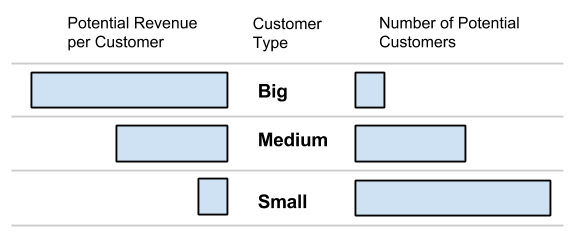
Customer Segments

In this simplistic customer segmentation, we have three types of customers: Big, Medium and Small. Note that while the potential revenue for a Big customer is much higher than Small customers, there are many more Small customers than Big customers. The labels Big, Medium and Small will have different meaning depending on your business. Big might refer to the size of the company (large enterprise) or complexity of the customer needs (custom solutions). The important factor in this segmentation is the inverse relationship between potential customer value and number of potential customers.

While you might be able to pursue Small, Medium or Big customers, you are probably not capable of pursuing all at the same time. The sales strategy for each segment will be different:

  • Big Customers require large amounts of time in sales and account management by dedicated salespeople. The sales cycle (total time to close the sale) may be measured in quarters.
  • Small Customers require self service products and strong marketing. Since revenue per customer is low you cannot afford to have a salesperson talk to all of them. So, you need to rely on customers finding you and signing up entirely on their own.
  • Medium Customers require a combination of an outbound sales force and strong marketing to reach them cost effectively.

Your target customer segment will dictate your sales strategy and hence your business strategy for the near term. It is important that you choose your segment wisely since it is easy to fall into some common traps:

  • The Over-Reach: You focus on Fortune 500 customers because you want brand name reference customers for your company, but you only have 6-9 months of runway. That’s not long enough to both complete the sale to companies of that size and raise additional funding, since the sales cycle for large enterprises can be 12-18 months.
  • Going Too Big: You focus on consumers but you have a complex product that they can’t understand without someone explaining it to them. You spend a lot on marketing in hopes of reaching tens of millions of consumers but can’t convert any of them, burning through all your capital.
  • Too Much TLC: You focus on a small customer segment with the goal of providing perfect customer service and spend a lot of time with each customer. Unfortunately, the segment isn’t large enough to support your business model and your deep customer service prevents you from growing your customer base fast enough.

Remember that the example customer segmentation here is simplistic and you should decide on the appropriate segmentation for your potential customers. Whatever you choose, make sure the segmentation reflects the market data you have available and not just your gut instinct. There is nothing worse than choosing to pursue Big customers, only to find out they don’t exist.

It may feel like you are giving up a big opportunity when you segment potential customers and only focus on some of them. That is only true in the short term, while your resources are limited. If you are successful with your first few customer segments, you can eventually grow to tackling all potential customers.


The Only Thing That Matters

When you are building a company, it is easy to be overwhelmed by the number of things that have to be done just to keep your company running. Between accounting, paying bills, signing contracts, financial planning and payroll you might find yourself spending half of your time just on operations. If you have never done these kinds of things before you might spend all of your time learning and doing them until you get proficient. It can be fun to learn and makes your new business seem like a real business.

The problem is that none of it matters.

At all.

Not even a little.

No company has ever been acquired because it paid all its bills on time, had flawlessly accounting ledger, perfect financial planning or impeccable contracts. Those are just the table stakes to play the game.

Absolutely the only thing that matters to your new company is whatever makes you different. That difference is what separates you from the competition and makes you stand out as a better solution. That difference makes you better. It is your competitive advantage (See Never Play Fair) and it underlies everything from your sales pitch to your strategy. If you do raise investment or get acquired, it will be because of that difference.

You should spend 100% of your time investing in your differentiation. Make it better. Make it obvious how you are different. Think of it like a wedge that you are using to split the market wide open and keep hitting it. Be relentless and focused on winning through your differentiation.

This extends to “feature parity” as well. If you look across all your competition and create a feature comparison matrix (See Only the Paranoid Survive), there will be a lot of features everyone else has that you lack. You could spend your time adding those features to get even with the competition, but what does that get you? If you look exactly like them why would anyone choose you? You should understand those gaps but invest in your differentiation.

What about all those operations that your company needs to run? Outsource. Pay people to do them for you. Don’t think of it as a cost, think of it as an investment. Every hour you pay for them to review contracts, pay your bills or run payrolls is an hour you can invest in your company’s differentiation. You are buying time, which is a rare commodity for start up companies, and investing it in the only thing that matters.

If you succeed, your differentiation will be so clear that it will be easy to create marketing materials, sales pitches and investor presentations. That differentiation will be how you recruit employees, close partnerships and build value. The message of your company will be told through your differentiation because that will be the story of why you are the best in the market.

Even if you pay your bills late.

Financing: A Tale of Three Companies

Image licensed under creative commons by Fornax, 2010.

If you want to start a company you might wonder where you will get the money your new business requires. The good news is that you have many options, as long as your business plan is sound and the market opportunity is big.

But, before we get to that, don’t confuse the money your business requires with the money you require to maintain your lifestyle – investors will not invest in you so you can pay your mortgage or make your car payments. Investors invest in your company to get a return so if you want to raise some capital you need to present them with a good investment opportunity that is likely to provide a return. It’s up to you to figure out how to cover your lifestyle expenses until you can pay yourself a decent salary, either through your savings or secondary income.

Assuming you have your personal expenses covered, a good business plan and your investment has a potential of return, there are many ways to raise capital for a business and we will cover three of them here. For these examples, let’s assume that you think that the market for umbrellas is going to expand quickly over the next few years due to global warming. Here, then, are the tales of three businesses started to take advantage of the upcoming umbrella explosion and how they might finance themselves:

1. Cash Flow Financing: The Umbrella Store

You decide to start an umbrella store, where people can choose from dozens of different models of umbrellas (either a physical store or online or both). The start up costs only include purchasing some initial inventory and setting up your store, but you are confident that sales can cover that cost. If you do well you might open up other stores, but you will wait for the market to demonstrate demand.

The best option is to finance the company yourself via cash generated from sales at your store. You will put up the initial money from your savings and the more umbrellas you sell, the more you will buy to increase your inventory. It might take a while but you think you can build up a healthy store that can support you and potentially a few employees.

Quick summary of your umbrella store:
Start up costs: $10,000
Estimated Annual Revenue: $150,000
Investors: You

In general, cash flow financing is a good idea if:

  • Your business will start generating revenue on day one.
  • Your start up costs are low.
  • You want to maintain complete control of your business.
  • You are not sure what form your business will take.

Cash flow financing is a bad idea if:

  • You can’t afford to provide the initial capital for the company yourself.
  • Your business needs to grow quickly to take advantage of a market opportunity.

Examples of the kinds of businesses funded via cash flows are consulting businesses, services businesses and small stores.

2. Crowd-sourced Financing: Umbrella 2.0

You design a new kind of umbrella, something the world has never seen before but is definitely better than all of the other umbrellas on the market. The cost of manufacturing the first batch will be significant because of the cost of setting up manufacturing, but after that you can easily grow the business based on sales revenue.

The best option is to crowd-fund your company by raising a little money from a large number of people. Using platforms like Kickstarter or AngelList, you can quickly find a large number of people who believe in your vision for a new umbrella and are willing to back you. In some cases, like with Kickstarter, you are pre-selling the product while in other cases, like with AngelList, you are giving them a small ownership in your company. If your start up costs are not very large, you can just raise funding from just your friends and family without needing to recruit investors that you don’t know.

Quick summary of your new umbrella product business:
Start up costs: $100,000
Estimated Annual Revenue: $1,500,000
Investors: Friends, family and/or strangers on crowd funding platforms

In general, crowd funding is a good idea if:

  • You require a large amount of startup cash but will be cash flow positive afterwards.
  • Your product will appeal to a wide range of people.
  • Your business will grow slowly.

Crowd funding is a bad idea if:

  • The amount of start up cash you need is very small or very, very large.
  • Your product is complex and will take many years to create.
  • Your business needs to grow very fast to take advantage of a market opportunity.

Examples of the kinds of businesses funded via crowd funding are new consumer products and non-profits (charities).

3. Venture Capital Financing: Build Your Own Umbrella

You want to build an online marketplace for people to design their own umbrellas and then have manufacturers build them on their behalf. The potential of the business is huge, but it will take a few years to grow the marketplace to break even and you don’t have a large window of opportunity so you need to move fast.

The best option is to raise venture financing. Venture capitalists and angel investors invest large amounts of money in high-growth companies with the expectation of a 10x return in under 10 years. The risk is high since your company needs to be extremely successful, but the reward is very high as well.

Quick summary of your umbrella marketplace business:
Start up costs: $1,000,000
Estimated Annual Revenue: $150,000,000
Investors: Venture capitalists and Angel investors

In general, venture capital financing is a good idea if:

  • You require a large amount of time and cash to build your business.
  • You expect your business to grow very fast (double every 3 months).
  • You need to spend ahead of revenue to fund your growth.
  • Your market opportunity is vast.

Venture capital financing is a bad idea if:

  • Your business will grow slowly.
  • Your market is small.
  • Your capital needs are small.

Examples of the kinds of businesses funded via venture capital are software-as-a-service companies, new drug manufacturers and new chip design companies.

So, what’s your best option?

Hopefully it is clear at this point that the best option for your business depends a lot on what your business is, how fast it will grow and how big it might become. Choosing the right option can be critical to your success or instrumental in your failure. Trying to fund a high-growth company on cash flows can starve your business since you will move too slowly and miss the market opportunity, but raising venture capital for a slow growth company can lead to unhappy investors and poor results for founders.

In many cases companies will combine strategies for the best outcome. For example, you might crowd fund your company to get started only to later raise venture capital financing when you start growing quickly. Or, you might grow using cash flow until you have a big opportunity for expansion and use crowd funding to take advantage of that opportunity.

There are, of course, other options than those listed here, including bank loans, and depending on where you are based those options may be most accessible. Network within your local community to understand the most common options.

Think about your business and what makes the most sense for financing options. But remember that investors are investing in your business, not your mortgage, so be sure to show them why their money will result in a big return.

How I Can Help

I receive many requests for help from entrepreneurs based on my experience and the content of this blog. While I enjoy helping, I am not always the best person to help depending on the problems you are facing. To help save both of us time, I’ve put together a list of the main ways I can help you build your company. You can find it on my website or in this post below.

This list was inspired by Leo Polovets (who has a great blog that you should read) and his “Ways I Can Help” post. If you think I can help you based on what you see here, feel free to contact me as I’d love to help.

How I can help you build your business:

1. Leadership and Team Building

Over the past 20 years as a CEO and CTO I have built teams as small as 3 and as large as 100 across multiple industries, hiring everyone from interns to senior executives. I can act as an executive coach for you and help you improve your management skills, and/or help you with any of the following:

  • Recruiting and interviewing strategies.
  • Onboarding processes and team mentorship.
  • Providing effective feedback and performance reviews.
  • Team motivation and chemistry.
  • Dealing with problem employees.

2. User Interface/User Experience Design

I have spent over 15 years building award winning user interfaces for both consumer and enterprise companies, working as both an independent designer and with some of the top design firms. I can help with:

  • Usability studies and customer surveys.
  • Wireframing and user flow designs.
  • Visual design including color palettes and font choices.
  • Design reviews and peer evaluations.

3. Marketing and Sales Strategies

I have successfully grown businesses from zero to hundreds of thousands of customers and tens of millions in revenue. I can help with:

  • Designing your launch plans and messaging.
  • Building a customer communications plan.
  • Refining your sales pitch.
  • Preparing for investor pitches.

4. Complex Algorithm Design

I have a Masters degree in computer science with a focus in Machine Learning, which I have applied to complex problems faced by real businesses. I also provide open source libraries that implement common machine learning and other complex algorithms. I can help with:

  • Complex algorithm design and evaluation.
  • Machine Learning applications, model and feature selection.
  • Complexity analysis.

5. Large Scale Software Systems Scaling

At Flurry, I built one of the largest data processing systems in the world spanning thousands of servers and multiple data centers. I can help with:

  • Capacity planning and load testing.
  • Security and compliance protection.
  • Large scale/distributed software architecture.
  • Systems design and monitoring strategies.

6. Analytics and Business Intelligence

I have helped dozens of companies across a dozen industries design their Key Performance Indicators (KPIs), metrics dashboards and analytics to help improve their business. I can help with:

  • Analytics tool selection.
  • KPI selection and monitoring.
  • Metrics investigation and analysis.
  • General business analysis and intelligence.

Hire Before Its Too Late

Hiring is a lot like fighting a fire, if you wait too long to deal with it then it might have already burnt your house down. In the early days of your new company (even when it’s just you), there are always a ton of great reasons to wait on hiring. You’ve probably thought to yourself:

  • I can’t afford another salary right now.
  • There isn’t enough for another person to do.
  • I really need to do this myself to make sure it’s done right.

All of those sound like reasonable justifications for not hiring, but they are really just excuses. Hiring is intimidating, time consuming and hard to do well so you will avoid it as long as you can. At the same time, it is one of the most critical factors in your success.

To be successful, you need to be able to make the decision on who to hire and when.

The Power of Focus

A very good rule of thumb for who you need at your company in the early days is that every essential function at your company should have at least one person whose entire focus and responsibility is for that one thing.

Every essential function at your company should have at least one person whose entire focus and responsibility is for that one thing.

While the term “essential function” might seem vague, it covers anything that your company MUST do well to succeed. For example, if you are counting on your launch to have a big impact there should be someone on your team who is solely focused on the launch. If you are scaling up a complex software platform, someone should be solely focused on scaling. If you are raising funding, someone will be spending all of their time on fundraising. The person assigned to each task might be the CEO, a co-founder or an employee but it needs to be someone.

Why is it so important to have someone dedicated to that function? Can’t you just split the work among the team you have? Sure, but then you are splitting focus and accountability. If you have two top priorities you will only spend half of your time on each and hence do each half as well as you could. Having a sole priority means that someone will do a great job and be held accountable for performance with the rest of the team. If something is essential to your company’s success you cannot afford to have someone do less than their best.

Does it mean everyone only does one thing? No, but every essential function needs a dedicated person. If you have as many people as essential functions then, yes, everyone has only one thing to focus on. Perhaps that means you should hire some more people.

The list of essential functions is entirely up to you and very dependent on your business. However, it should already be reflected in the top priorities for your business that you review with your team regularly and are baked into everything that you do. If you have a top priority that does not have a dedicated person next to it, then it’s time to start hiring.

Get a Head Start

Even if you have made the decision that you need to hire to fill an essential function, you can still fall into the trap of putting it off. You will be busy in the chaos of building your business and with all of the short term urgent issues the long term benefits of hiring seem easy to put off.

However, putting off hiring is a dangerous trap. If you don’t anticipate and hire ahead of your needs then you’ll find yourself stalling out and suffering later. You can’t just snap your fingers and make employees appear after all. Consider that even if you decide to hire someone tomorrow you still need to spend the following amount of time:

  2 months searching for the right candidate
+ 2 weeks notice at their current company
+ 1 month training before they are productive
  ----
  3.5 months lead time

And that assumes they don’t take any time off between jobs. For sales people you need to assume another 2 months after training before they are productive because you can’t close deals the minute you start selling. That means that you need almost 6 months lead time before sales people will be productive after you decide you hire one.

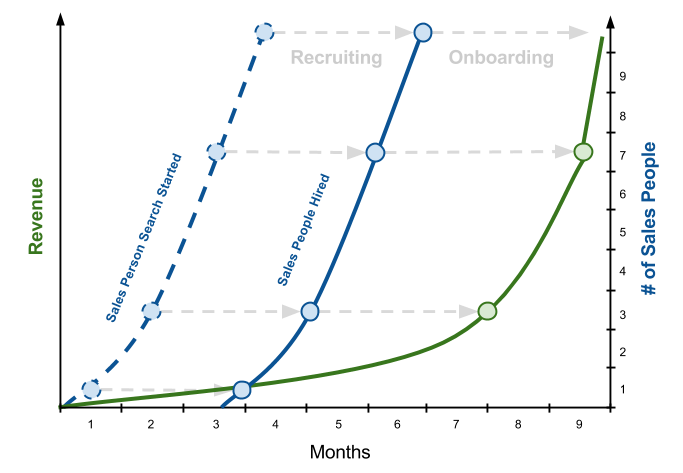
To put it in perspective, let’s say you are an enterprise sales driven company (revenue is derived from sales people) and you have a revenue forecast that has you growing by 10x in nine months. Your hiring plan should reflect that you need to grow your sales team by an equivalent amount and account for lead time before they become productive.

Hiring Ahead Correctly (1)

In order to meet your aggressive nine month revenue growth plan, you need to start recruiting aggressively in the next three months with the goal of hiring one new hire in month 3, 2 in month 4 and 4 in month 5. This assumes equivalent production per salesperson which is a safe assumption and plenty of lead time for both recruiting and on-boarding.

If you had taken a conservative approach to hiring and only hired 1 sales person per month, you would have failed before you even started. Nine months later you would wonder why you are falling short of your plan and why it’s taking so long to ramp up your team.

This example uses sales people, but the same principle applies to engineers, marketers and every other part of your business. If you don’t think you can hire enough people to meet your plan based on the lead time to productivity, perhaps you need to revisit your goals. If you MUST reach your goals, then you better hire ahead of the goal.

Hiring is Selling

Even after deciding who to hire and giving yourself enough lead time, you will probably fall back on the final excuse: I can’t afford another person right now.

That might be true, very few new businesses can afford the salaries of their founding team and definitely can’t afford new hires. Regardless, that should not stop you. As an early stage company you can offer prospective employees things they can’t get elsewhere: large amounts of equity and the chance to be in on the ground floor of a huge company.

Many people work for start up companies for fractions of a percent ownership later in their lifetime when there is less risk. Many of those same people would jump at the chance to own a few percentage points of a new company, even if they need to work for much less salary or even minimum wage. Don’t worry about giving these people a generous equity package because they will become the leaders as your company grows, hiring and building teams of their own. You want them to feel as much ownership in your company as possible.

Also remember that as you become more successful, you will start paying better salaries. Someone who joins you early for a lot of equity and a low salary will eventually get a better salary, and still own their equity. Many people would take that trade and live off their savings for 6-12 months, especially the kinds of people you would want to hire.

In the end, hiring is hard and it’s easy to put off. However, the satisfaction you get from hiring great people to fill important needs for your business and see them contribute to its success is one of the best rewards.

You Are Your Corporate Culture

Corporate culture is an elusive thing. Everyone agrees that you need to have a great one, but no one can really define what it is and what makes a given culture “great”. You can read books about legendary corporate cultures like they have at Zappos, but the lessons you learn never seem directly applicable to your company.

How then do you build the kind of corporate culture you want?

In reality, you start defining your corporate culture the minute you start your new company. You might not even realize it, but the decisions you make (and more importantly how you make them) add up quickly into a culture. For example, do you:

  • Discuss major decisions with your team or delegate responsibility to one person?
  • Communicate status in person or through written documents (git comments count)?
  • Involve everyone in hiring decisions or just a small team?
  • Use outsourced help or not?

There are no right or wrong answers to any of the above, but as you choose you start to define your company. You make dozens, if not hundreds, of these decisions everyday in the first few months of your company and eventually they add up. As new employees join, they see the company as the sum of the decisions you have made which in turn shapes how they interact with the company and contribute to the culture. Eventually, a small decision you made early made can affect how a team of hundreds of people goes about doing their jobs.

With that in mind, you have three levers for controlling how your corporate culture evolves:

  1. The types of people you hire. When you first start you have no culture as a company, only personalities as individuals. Those personalities, and the decisions they lead you to make, will start forming the basis of habits which become process which becomes the lifeblood of your company. The best way to end up with a culture you want is to start with personalities you like and decisions that you want to stand by in the future.
  2. The decisions you makeThink about the culture you would like your company to have a few years down the road and make decisions that people at that company would make. Again, decisions become processes before you know it so be sure that any decision you make is one you would make again and again. Define a mission that can act as a guide for future employees who face decisions, like yours, that might shape corporate culture.
  3. The incentives you give your team. People will always tend to do what is in their best interest so it is important to align their incentives with not just what you want them to do but how you would like them to do it. For example, if you want a culture that values customer happiness, make sure that your sales people are not just compensated on closing the deal, but also on whether that same customer makes additional purchases in the future. With the right incentives in place you will find that the behaviors you want to encourage become part of the operating fabric of the company.

The best way to see if your corporate culture is growing the way you like is to test it on a regular basis. Challenge your team in ways that require them to lean on the culture of the company such as shuffling their responsibilities for a day. If everyone showed up tomorrow and had to do a different job than they knew, how will they communicate and how will they work together? It can tell you a lot about whether you are headed in the right direction.

Decisions become processes. Processes become habits. Habits become culture.

The good news is that if you succeed in building a healthy corporate culture it will become a virtuous cycle, as you will begin attracting the kinds of employees who want to be part of the culture you have created. Attracting more and more like-minded people will increase the strength of the culture even further, attracting even more people.

If you understand the culture you want to have and start, from the beginning, to lay a solid foundation it is likely that one day you will show up for work and have the kind of company you always wanted to build and a place where you love to work. That is one of the most fulfilling achievements of all.

Confidence vs. Arrogance

Starting companies is hard, and it is true that the world is out to get you. It is no coincidence that many of the most famous entrepreneurs and CEOs of Fortune 100 companies are borderline narcissists. In order to overcome the armies of naysayers you need a preponderance of confidence, bordering on arrogance. While everyone is telling you ‘no’, you need to continue to respond ‘yes’.

However, it is dangerous to cross that line. Arrogance can make you sloppy and lead to mistakes. You need to be confident enough to believe in yourself when no one else does, but humble enough to realize that you will only succeed if you execute flawlessly.

If you’re afraid you are near the edge, take the following quiz and find out if you are Confident or Arrogant:

1. Do you think or know that you are better than your competition?

Arrogant Answer: You think you are better than your competition because you have worked really hard, you like your product a lot more than your competition and imagine your customers must as well. This also applies if you think a great new feature you will release next week will change the market overnight.

Confident Answer: You know you are better than your competition because a majority of your customers tell you that you are, or better yet if your metrics demonstrate it. You have done a full competitive analysis and understand your strengths and weaknesses as well as expected changes in the industry over the next twelve months.

2. Do you think or know that your employees are happy?

Arrogant: You think your employees are happy because you are happy and they seem to have fun around the office. You throw office parties and have social events on a regular basis that you enjoy, so they should as well.

Confident: You know your employees are happy because you ask them regularly. You understand why they like working for your company, where they aspire to go in their careers and are doing your best to help all of them achieve their goals. You still have social events, but you ask your team what they like to do instead of just doing what you want. 

3. Do you think or know your investors are happy with your performance?

Arrogant: You think your investors are happy because your metrics are improving and you are in a hot space. You assume that since they don’t ask many questions during your board meetings that you have already answered them.

Confident: You know your investors are happy because you have asked them about their expectations for your company’s performance and how it relates to their investment strategy. You brief them about important events ahead of board meetings and meet with them individually on a regular basis to get their private feedback.

4. Do you think or know you have enough capital to reach your next milestone?

Arrogant: You think you have enough capital because your revenues are going to increase and investors will be excited at the opportunity to invest when you start fundraising in a few months. Besides, you have plenty of money in the bank.

Confident: You know you have enough capital because you understand your cash flow model and have worked out the worst case scenario. Based on your current model, even if things don’t go according to plan, you will have 9 to 12 months of runway left when you start fundraising again.

5. Do you think or know you are not burning out?

Arrogant: You think you are fine because you are not afraid of hard work, eagerly working 20 hour days and weekends for 2 years. You feel so close to breaking through that if you push just a little harder for a little longer, you will get there. You don’t think your team performs as well when you are not around, so you work even harder.

Confident: You know you are fine because you have a support network that helps you understand how you are performing and you ask them regularly. You take regular breaks to decompress and gain perspective, while trusting your team to work in your absence.

So, how did you score? Over the years, I’ve both passed and failed this test many times.

It is easy to lose yourself in the day to day chaos of building your business and in doing so cross the line. It is easier to believe you will win because you are better than to make sure you are executing well enough to win based on your merits. Self-evaluation is a critical skill to develop to make sure you maintain healthy perspective.

Stay confident.